


Demography - Measuring And Modeling Population Processes
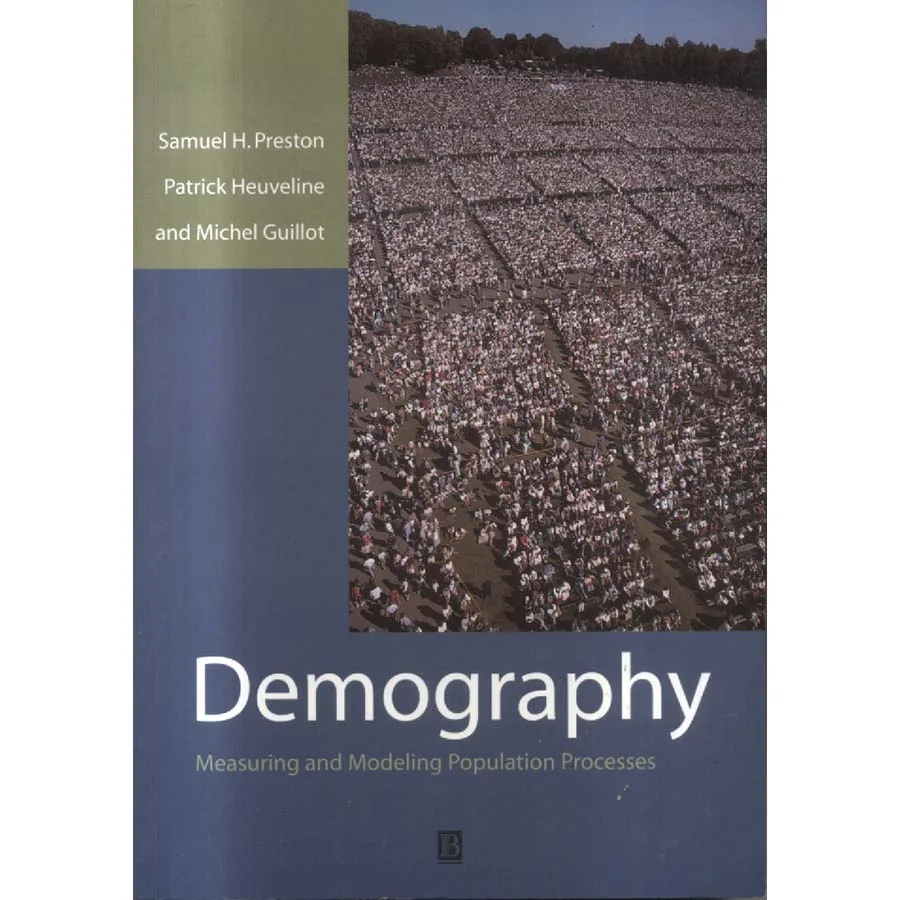
Publisher: Blackwell Publishing
Format: Paperback
ISBN: 9781557864512
There are books that tell stories, books that teach skills, and then there are books that calmly explain how to measure the rise and fall of entire populations with enough mathematical precision to make a census officer weep with joy. Demography: Measuring and Modeling Population Processes firmly belongs in the third category, proving once and for all that humanity itself can be graphed, modelled, projected and occasionally persuaded to fit inside a particularly elegant equation.
Written by distinguished demographers Samuel H. Preston, Patrick Heuveline and Michel Guillot, this has become one of the standard university texts on the science of populations. Birth rates, death rates, migration, fertility, life expectancy, age structures and population growth are all carefully unpacked with remarkable clarity. It turns out that behind every headline about ageing societies, baby booms or population decline lies an army of statisticians quietly wrestling with probabilities rather than crystal balls.
Fortunately, this isn’t simply a catalogue of intimidating formulae designed to frighten unsuspecting students into changing degree courses. The mathematics serves a purpose, illuminating the forces that shape societies across generations. Why do populations grow? Why do they shrink? Why do some countries age rapidly while others remain youthful? How can governments anticipate future demands for schools, hospitals or pensions? This book tackles questions that influence everything from public health and economics to urban planning and international development.
There is also something wonderfully ironic about the subject. Every one of us likes to think of ourselves as gloriously unique, impossible to categorise and entirely unpredictable. Demography politely thanks us for our contribution before placing us into an age-specific cohort, assigning us a survival probability, estimating our fertility contribution, projecting our migration likelihood and adding us to a graph with several million other equally unique individuals. Individuality remains intact, of course—it’s simply averaged with impressive statistical confidence.
Despite its academic credentials, the writing is notably accessible for such a technical field. Complex concepts are introduced methodically, examples build naturally upon one another, and the authors clearly remember what it was like to encounter life tables and hazard rates for the first time. Rather than assuming readers already speak fluent statistics, they patiently guide them from basic demographic measures towards sophisticated population models that underpin much of modern social science.
This 2002 Blackwell Publishing paperback is in Good condition. It bears the honest signs of careful academic use rather than neglect, remaining clean, solid and entirely ready for another generation of students, researchers or intellectually curious readers determined to discover why entire nations can sometimes be understood through surprisingly elegant mathematics.
Ideal for students of demography, sociology, economics, geography, epidemiology and public policy, or indeed anyone who has ever wondered how experts confidently predict that a country will contain 72.4 million people in twenty years’ time without first knocking on every front door. A serious, authoritative and surprisingly fascinating work that demonstrates the world is full of patterns—provided you’re prepared to count absolutely everybody first.
Keep browsing: See more Academic books Other books by Samuel H Preston Patrick Heuveline and Michel Guillot
